
You are currently viewing a placeholder content from TrustIndex. To access the actual content, click the button below. Please note that doing so will share data with third-party providers.
More Information
An archive relocation is not an ordinary move. As soon as files, personnel records, confidential documents or data carriers are involved, data protection, access control, documentation, and maintaining the archive order become the main priorities. A secure file or archive move must be organized in such a way that inspection is excluded, handovers are traceably logged, and holdings can be clearly allocated again at the destination.

Gebr. Roggendorf GmbH from Cologne supports archive relocations, file relocations, registry relocations as well as the transfer of corporate archives, authority archives, and personnel files, both nationwide and internationally. Focus: GDPR-compliant processes, seamless tracking, and audit-proof documentation.
An archive relocation involves the structured transfer of file holdings, including planning, packing, transport, unloading, filing, and, if desired, storage or interim storage. The crucial factor is that security and order are not lost along the way.
1. GDPR-compliant protection of personal data,
2. Preservation of archive order/file plan/references,
3. Complete documentation of all transfers and holdings.
A file relocation stands and falls with a clean project plan. Depending on holdings, access, and security requirements, the process is organized in stages, especially if operations must continue in parallel.
Typical modules include: inventory, security and authorization concept, packaging and labeling logic, scheduling, handover points, as well as clear responsibilities for packing, transport, and unloading.
The duration of an archive move depends less on square meters than on the amount of files, the filing system (file plan/registry), access, security requirements, degree of inventory, and whether storage, interim storage, or destruction should also be integrated.
As soon as personal data is involved, processes must be designed so that unauthorized access is excluded during packing, transport, and unloading.
Access is regulated by an authorization and access concept. This applies to packing areas, transport routes, unloading zones, and handover points at the destination. The goal is that files are never “open” or accessible without control.
For sensitive holdings, confidentiality agreements (NDA) and clear instructions are part of project security. These regulate how to handle confidential information, personnel files, administrative documents, and other sensitive documents.
A key security factor is choosing suitable transport containers. Especially for personnel files or particularly sensitive archives, solutions are often needed that make tampering visible.
Sealed or locked containers provide clarity: they reduce the risk of unauthorized inspection and enable traceable control of transfers. Combined with documented handover points, this creates a robust security standard.
Depending on the inventory, archive boxes, archive cartons, file boxes or hanging file folders are used. The key factor is that the packaging not only protects, but also enables clear assignment to the archive order.
For many organizations, the greatest concern is not the transport itself, but the question: “How do we ensure that we can find everything again after the move?”
An orderly archive move is based on clear labeling and sorting logic. Files are packed and transported in such a way that the sequence in the file plan or registry remains traceable, even during interim storage or stages.
If a new structure is desired (e.g., new registry logic or a move of several departments), reorganization is planned as a separate work package. This way, the move remains manageable and the order at the destination is clear.
In archive relocations, traceability is often a must, internally (compliance) or externally (audits, reviews).
Inventory can be recorded via barcode scans, label systems, or structured lists, depending on the holdings and required level of detail. A consistent logic is important, ensuring a later fit for storage or filing.
For especially sensitive holdings, a “chain of custody” may be sensible: handover points are clearly defined and documented so it is always traceable who handed over and took over a unit and when.
Depending on the project, handovers are mapped by handover protocols, scan lists, or documented milestones. This creates transparency, simplifies approvals, and reduces uncertainties during follow-up.
The destination location is not always fully available right away. In such cases, interim storage or warehousing is part of the concept.
Storage makes sense when move stages are separated in time or areas at the destination are only available later. The decisive factor is that storage and access concepts are clearly regulated, especially for files with personal data.
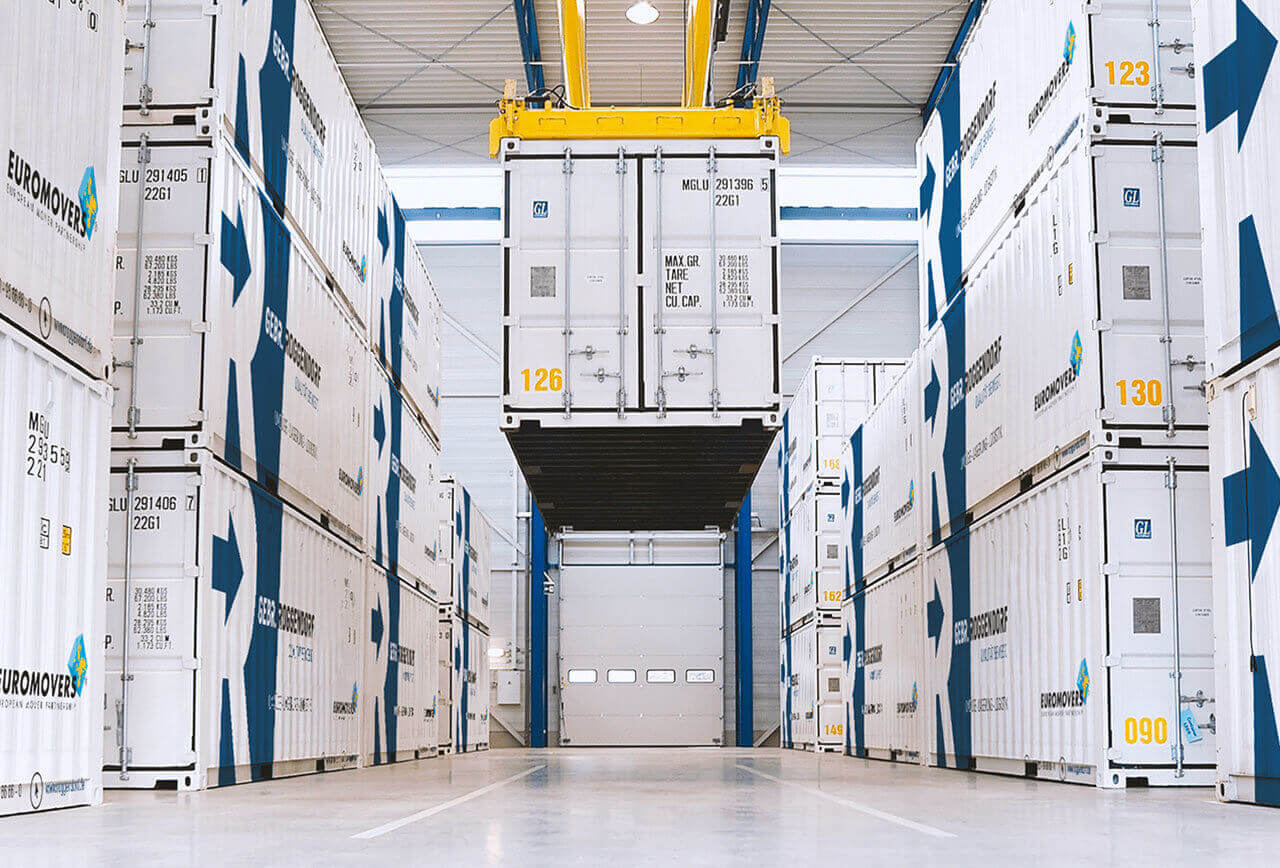
In addition to interim storage during a move, we also offer permanent archive storage. Our containers are equipped with shelving systems for archive boxes, ensuring that holdings can be stored in an organized, accessible, and secure manner.
Specially designed shelving systems for archive boxes
Secure, climate-controlled storage conditions
GDPR-compliant access control and documented entries/exits
Clear inventory and quick access as needed
Combination possible with relocation and digitization

Many organizations use a move to clean up holdings, but only within the scope of the applicable retention and compliance requirements.
Old files cannot just “go away.” What matters is which documents must be retained and what can be legally sorted out. A clean separation during the process reduces later risks.
If file destruction is part of the project, destruction or disposal documentation is essential. This documents exactly which holdings have been destroyed in a data protection-compliant manner.
In addition to paper files, data carriers are often also involved, from backup media to hard drives or other storage systems.
Data carriers require special protection and security measures. These include suitable containers, controlled handovers, and a clearly defined access and authorization concept to prevent unauthorized inspection or tampering.
With confidential documents, it is not just about transport damage, but also about risks like loss or unauthorized inspection.
Insurance coverage and liability issues are clarified for each project, tailored to the holdings, security measures, and extent of documentation. The goal is a transparent framework that realistically covers the risks.
The cost of an archive or file relocation depends heavily on the security and verification requirements involved.
• Amount and structure of files (archive/registry/personnel files)
• Desired inventory (lists/barcode/tracking)
• Security level (seals/locks, access control, chain of custody)
• Access and routes (floors, elevators, time windows)
• Storage/interim storage
• Optional file destruction with proof
• Data carrier handling and documentation scope
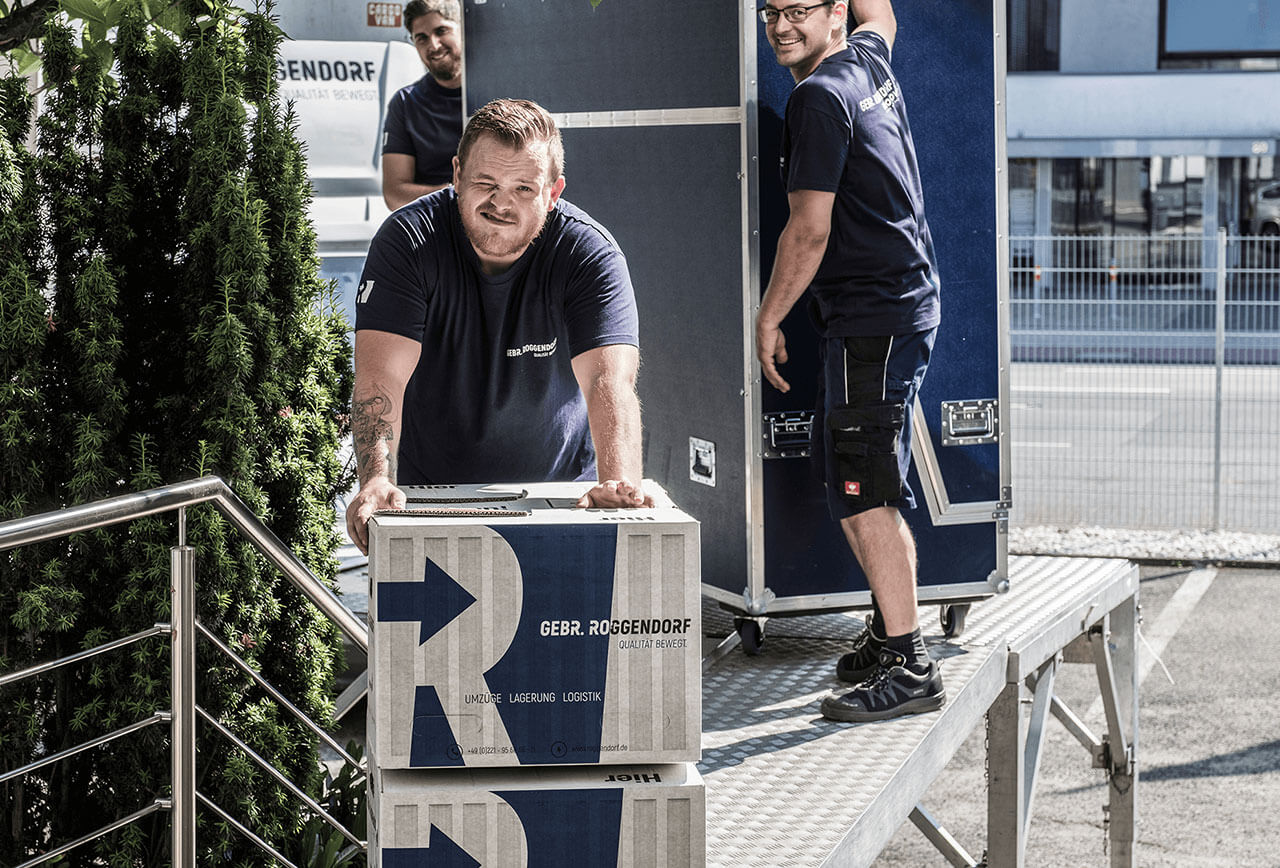
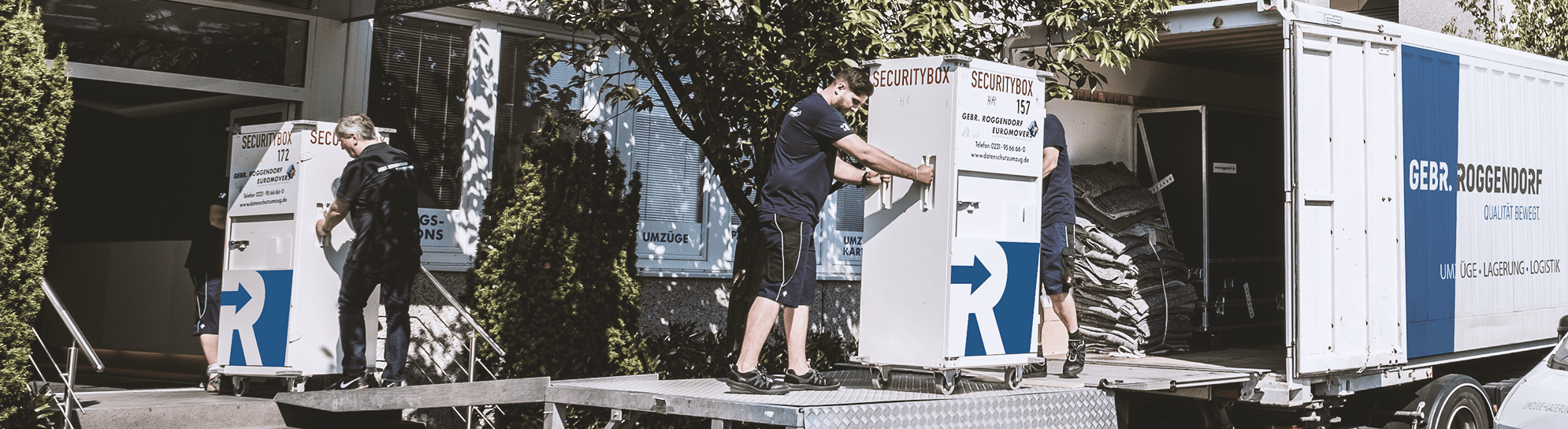
For file and archive relocations, less importance is attached to general statements and more to proven experience under similar conditions: sensitive data, compliance, documented transfers, compliance with order, and secure process management.
References are only useful when they are comparable in scope, type of holdings, and security requirements, e.g., registry relocation, personnel file relocation, authority archive or company archive.
Gebr. Roggendorf GmbH offers not only the relocation itself but the entire process chain for your archive:
✅ Archive relocation – GDPR-compliant, documented, order-compliant
✅ Archive storage – in containers with shelving systems for archive boxes
✅ Digitization – professional service through our subsidiary in Dormagen
✅ File destruction – data protection-compliant with documentation
We have extensive experience with complex archive and file relocations – from church archives to authority holdings and administrative archives. Here are some examples from our practice:
These projects show:
From church archives and authority holdings to large administrative moves involving several hundred workstations – we know the requirements for GDPR-compliant, documented, and order-compliant archive relocations.
Are you planning an archive relocation, file relocation, or registry move in Cologne, nationwide, or internationally? Gebr. Roggendorf GmbH supports you with GDPR-compliant processes, secure packaging, seamless documentation, and clear project management.
For a quick assessment, the following are especially helpful:
• Type of holdings (archive/registry/personnel files/data carriers)
• Desired archive order (maintain vs. reorganization)
• Requirements for inventory/tracking/chain of custody
• Security level (seals/locks, access control, NDA)
• Timeframes, access, possible storage or destruction
Request archive relocation now to ensure data protection, order, and traceability are reliably secured.
You are currently viewing a placeholder content from Vimeo. To access the actual content, click the button below. Please note that doing so will share data with third-party providers.
More InformationYou are currently viewing a placeholder content from YouTube. To access the actual content, click the button below. Please note that doing so will share data with third-party providers.
More InformationYou need to load content from reCAPTCHA to submit the form. Please note that doing so will share data with third-party providers.
More InformationYou are currently viewing a placeholder content from TrustIndex. To access the actual content, click the button below. Please note that doing so will share data with third-party providers.
More Information